Fictive Advertising Statement: Business/Economics, Symbol Systems/Myths and Dreams. (continued) page 2.
As Andrew Boyd of the brilliant culture-jammer mime campaign "Billionaires for Bush (or Gore)" notes "advertising imagery is the ultimate stealth virus. It has long been post- or pre-rational, operating by subconscious association, by veiled promise and threat, by mobilizing our longings and our dream world. Rational critique can't find a handle by which to challenge such a worldview."
Though advertising can seem trivial, it is actually carrying inside it our most prized beliefs. Some of the finest artists in the world work in it, and they receive a great deal of prestige and recognition for doing so. It is in some way similar to shamanistic practice in folk societies. Not that it is arcane or inscrutable but rather that it involves practitioners or technicians who must get at the heart of the collective dreams within a culture and then harness these. The sacred practitioners do it partly for their own ends, but also to move the culture forward in some ideal path they perceive as right, based on their reading of the dreams and traditions.
Fashion, too, can seem frivolous and inconsequential, yet when anthropologists study a culture, the cloths they wear, and the daily things they surround themselves with, tell a tremendous amount about who they are, how they live, what they care about, and how they see their place in the cosmos.
A lot of how we understand the world still comes from myths buried deep in our general culture's understanding. Advertising works on these myths, within the subconscious symbol system. Brands are little different from Totems. Providing strength, coherence, a path or organizing principle - a community of the like minded. A special society or group, separate from the others, a definition of self.
I don't think there can be an easy dismissal of advertising, despite its huge negative impact on creating a sustainable future, because its function is so central to our social structure and because it is working directly with our core cultural beliefs. Like other recent Fictive projects the key with "Fictive Advertising" is to acknowledge the beauty and at the same time critique the structure.
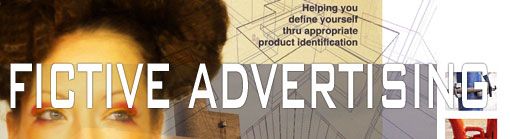
Rather than spoof a particular brand, it is an attempt to make reference to a host of styles, reflecting the whole genre of advertising. The use of the sexy dresses is a allusion to couture and high end ready to wear. The architecture refers to the anomic landscapes and empty urban environments used to promote hip hop sportswear. The little boxes and multi-section layout come from interior design ad aesthetic, and the wire frame or spot illustration comes out of youth culture alt/skate punk lifestyle looks.
There is a genuine attempt to acknowledge the value in these various forms, and at the same time their place within the symbol manipulation system. To get at a real understanding you have to acknowledge the strength, beauty, and value in the meanings, even as you reveal the abhorrent economic context.
Economic exploitation around the globe causes hate at being oppressed. We are belatedly waking up to this obvious fact. Terror is not justifiable. Ever. Period. We as a culture are not to blame for terror. It is also a poor tactic in that it leads to more oppression. The problem is that human suffering and human rights violations are coming back to haunt us, as normal people in exploited nations choose to support fanatics as the only way they see out of their own oppression. If they were actual participants in the largess of the global economic structure they wouldn't want to destroy it, as they would be hurting themselves. Instead, we get the hard earned value of their labor, and they are left hopeless and desperate. Meanwhile, we are constantly encouraged to want to get more. All of this economic truth is hiding behind ads.
Despite the concerted efforts of the World Bank and the WTO, I do not believe there is a Global Conspiracy of Western Corporate Industrialism to destroy the World nor of Advertisers to steal our minds. Rather there is an organic cultural process which we can ignore and allow to occur or which we can recognize, and attempt to alter. The first step in altering anything is to understand it. Like the Wizard of Oz, it may look big and shiny, all-powerful and inscrutable, but it is actually operating with basic processes, with gears and levers that we can grasp.
Kalle Lasn of the venerable ADBUSTERS notes "right now, corporations have the power. They beam their memes into our brains at the rate of a few thousand ads, brand logos and marketing thrusts per day." and further "Every outburst of cognitive dissonance is useful, but to mount a serious challenge against corporate rule, we jammers must build our own meme factory. Because we have severely limited budgets, our strategies must be perfectly crafted to tear gaps in the glitter of the consumer spectacle."
Jump in and work the stuff over. Squeeze it a little and see what pops out. Get out the scissors and start shaping. Fictive advertising: Doing our part to tear a few gaps in the glitter. Making some new glitter. Paying a little attention to the man behind the curtain...
-Paul Clay 2001